Inside the black box: Are board members really prepared for their meetings?

Board meetings remain one of the most important mechanisms of corporate oversight, yet how directors prepare for them is still largely a mystery.
The work that takes place before the meeting, the reading, note-taking, and reflection, is both expected and assumed, but rarely examined in practice.
A new research project led by Salome Lang, Head of Analytics at Sherpany, together with Markus Meierer from the University of Geneva and Robert Langan from ESADE, offers a rare opportunity to look inside that invisible process.
Drawing on anonymised metadata from over 100,000 board meeting interactions hosted on Sherpany’s platform, the research explores director preparedness through behavioural signals rather than assumptions or self-reporting.
The study, titled “Who has(n’t) Done their Homework? Examining the Preparedness of Directors for Corporate Board Meetings”, was awarded Best Paper at the 2025 ICGS Conference in Manchester, a vital checkpoint in the corporate governance calendar. The findings shared here mark the beginning of a broader initiative. The final paper will be published in 2026.
Register now for early access to the paper
What data was analysed and how was it used?
The research is based on anonymised metadata from Sherpany’s board management platform. It covers over 100,000 director-meeting interactions, collected between January 2023 and August 2025. The dataset was limited to metadata such as:
-
Login activity
-
Document access times
-
Timing of meeting publication.
As a result, the study was content-agnostic, and didn't include any content from agendas, documents, or meeting discussions.
Importantly, the research focuses on process. It looks at whether and when directors opened materials, not what they read or how they responded. This means that the data reveals insights into director behaviour while preserving vital privacy. It reflects how directors interact with meeting preparation workflows, without compromising the confidentiality of the meetings themselves.
What the early findings reveal about preparedness
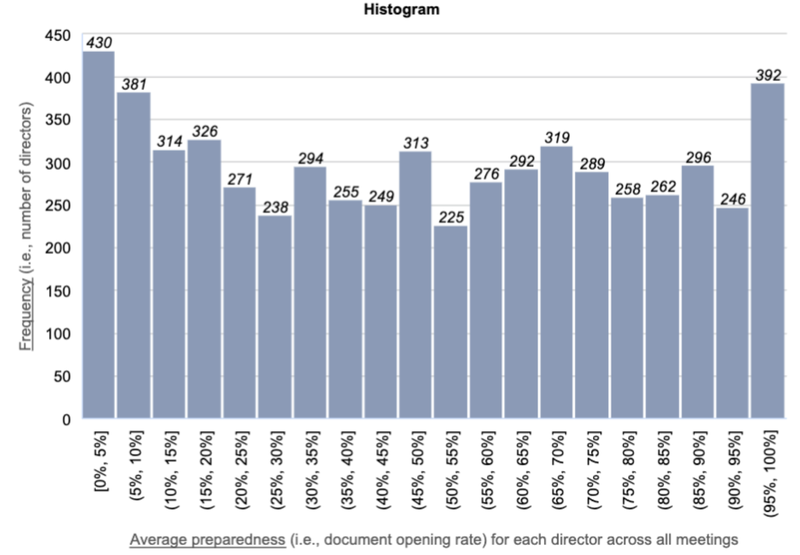
The initial findings in this study reveal that there is no single profile of a well-prepared board member. Instead, the data paints a picture of inconsistency, and while some directors show a clear pattern, most do not.
The findings show:
-
On average, directors are only partially prepared: The data does not suggest a baseline of full preparation across meetings.
-
A small group prepares consistently: These directors engage with materials in advance, meeting after meeting.
-
Another small group rarely prepares: Their document access before meetings is minimal or absent.
-
Most directors fall in between: However, this middle group is not stable. Rather than being somewhat prepared each time, they tend to swing between extremes, fully prepared one week, barely engaged the next.
In the chart below, we can see the preparedness levels from least (on the left) to most (on the right) with the number of directors who fall into each level (in absolute numbers):
Source: “Who has(n’t) Done their Homework? Examining the Preparedness of Directors for Corporate Board Meetings”, Salome Lang, Markus Meierer, and Robert Langan, 2025.
These fluctuations suggest that preparation is not just a question of discipline or ability. Other factors may be at play.
The headline finding is that most board members are only partially prepared, but this average masks a more complex and uneven pattern of behaviour.
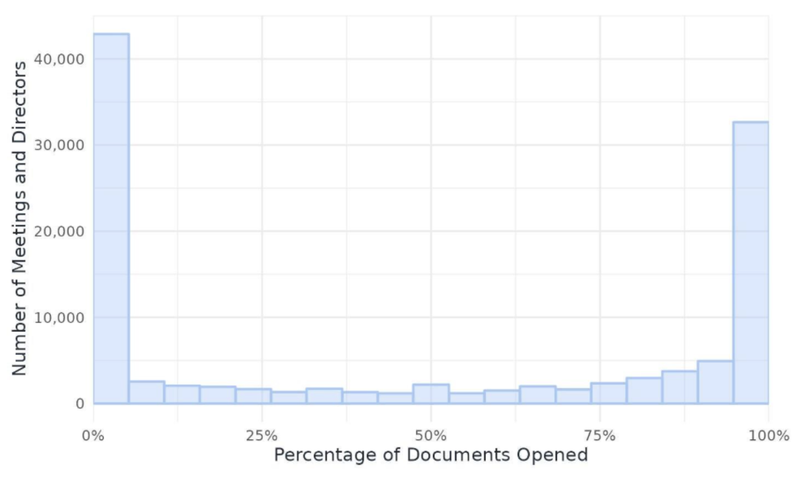
A small group of directors engage with materials well in advance of each meeting, another small group rarely engages at all, and the majority fall somewhere in the middle, but not in a predictable way. Rather than being moderately prepared each time, most directors swing between extremes. They might review every document in one meeting cycle, then engage minimally in the next.
Source: “Who has(n’t) Done their Homework? Examining the Preparedness of Directors for Corporate Board Meetings”, Salome Lang, Markus Meierer, and Robert Langan, 2025.
This inconsistency suggests that preparation is not a fixed personal trait. Instead, it seems to reflect the vast amount of pre-reading that is required for meetings, as well as context, capacity, and competing priorities. Directors are not always reliably prepared, even if their overall average suggests otherwise.
The research does not aim to assign blame or label behaviour. Instead, it provides a structured way to observe preparation as a real, measurable part of meeting effectiveness, and to distill these learnings into how meeting preparedness can be improved.
Why is board member preparation so inconsistent?
The fluctuations in preparation are not random. They reflect a range of underlying factors that shape how directors allocate their time and attention.
These include:
Competing responsibilities
Many directors hold multiple board seats, executive roles, or advisory positions. When demands overlap, meeting preparation becomes one of many tasks competing for time. Even well-intentioned directors may need to make trade-offs.
Group dynamics
The behaviour of one director can be influenced by who else is in the room. The research is testing the hypothesis that executive attendance and higher preparation levels are linked. Directors appear to respond to visibility, especially when their contributions are likely to be noticed by management or peers.
Director lifecycle
Experience and tenure may matter, too. New directors tend to prepare more thoroughly, possibly to build credibility. Departing directors often prepare less, particularly when they are no longer part of longer-term decisions.
Meeting conditions
Preparation is easier when conditions support it. The overall meeting structure, number of agenda items, timing of document publication, and even the time of day of meetings can influence engagement. These factors are often underestimated when assessing board performance.
Preliminary results indicate that context, particularly group behaviour and meeting setup, may be more predictive of preparation than individual characteristics alone.
How Sherpany supports better board meeting preparation
Preparation improves when directors are supported by tools that remove friction and reduce cognitive load. Sherpany’s platform is designed to create that support across every phase of the meeting lifecycle.
Preparedness insights
Meeting organisers can access anonymised scores that reveal how much time directors are spending with materials. This makes it easier to spot patterns and improve preparation across the group.
This helps identify the small changes that have a big impact. For example,. one Sherpany customer was struggling with poorly-prepared participants in their management meetings, whcih take place every Monday. When asked for more details, they shared that the agenda was published on Fridays. To give more time for effective prepared, we suggested publishing it 24 hours earlier. As a result, they saw a drastic improvement in meeting preparedness, demonstrating the significant impact of small changes in human behaviour.
Annotations
Instead of relying on memory, directors can highlight important sections, add comments, and organise their thoughts directly in the documents. These notes are visible only to them, and become a practical reference during the meeting.
AI features
With Sherpany’s AI Copilots, directors can reduce preparation time and increase the depth of preparation simultaneously. For example, automated document summaries that help directors grasp key points faster, the ability to ask clarifying questions without rereading lengthy materials, quick access to relevant insights from past meetings, and frictionless multilingual preparation through automated translations. This makes it easier to clarify key points and focus on what matters most.
Better collaboration
Templates and workflows guide meeting organisers to publish materials early, include built-in breaks, and reduce unnecessary agenda items. These features make it easier for directors to find the time and space to prepare properly. What’s more, directors can comment on documents and begin collaborating before the meeting begins, increasing levels of preparation, and decreasing wasted meeting time.
A single source of truth
Everything lives in one place. From reviewing materials to joining the meeting, directors work in a secure, unified environment. This continuity cuts down on distractions and makes preparation a seamless part of the meeting rhythm.
What’s next?
This research is still ongoing. The findings shared here reflect the first phase of a broader initiative to understand how board meeting preparation works in practice.
The model will continue to evolve over the coming months. Here’s what to expect:
-
Model refinement: The research team is reviewing feedback and continuing to test the model using additional data and variables. This includes looking more closely at director status, gender, tenure, and meeting characteristics.
-
Deeper insights: As more data is analysed, the team will begin to share insights that can help organisations strengthen governance, improve meeting preparation, and identify where support is needed.
-
Full publication: The final paper will be released in 2026 and will include a comprehensive summary of findings, methods, and implications for practice.
Register now to receive the full paper when it becomes available.
Please note: Data use for this study aligns fully with Sherpany’s strict approach to security and data privacy. If you would like to learn more, you can read our Privacy Policy and visit our Trust Centre.
Please note: Data use for this study aligns fully with Sherpany’s strict approach to security and data privacy. If you would like to learn more, you can read our Privacy Policy and visit our Trust Centre.
Here’s What You Should Do Next…
Learn How to Make Every Meeting the Best Ever
Our monthly newsletter delivers actionable advice through articles, interviews, and best practices.
No spam. Unsubscribe any time.
Get Answers to Your Board’s Most Pressing Challenges
Browse our articles, containing an amazing number of useful tools and techniques, including:
Discover How Sherpany’s Board Management Software Can Cut Your Meeting Preparation Time in Half
- Learn from the world's leading companies who are using Sherpany to revolutionise their meetings.
- Discover how Sherpany can transform your meeting culture
Or
Book a demo to see Sherpany in action